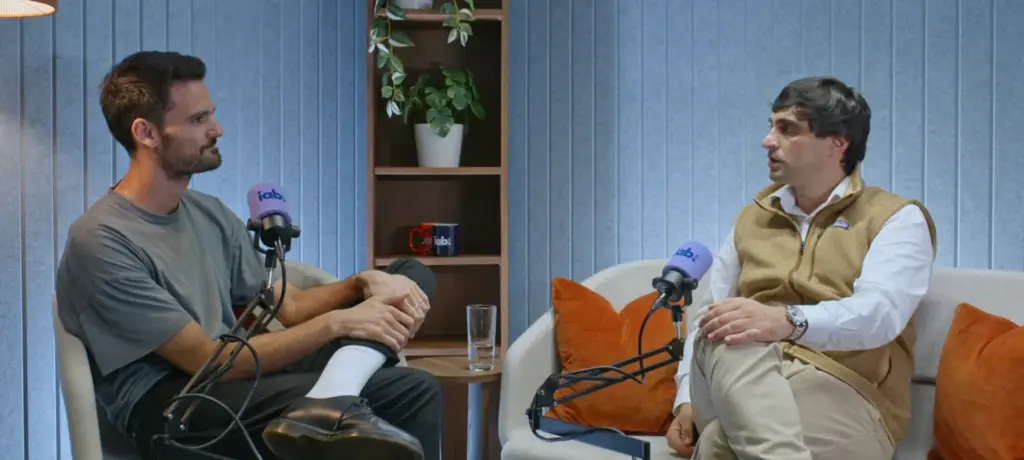
Marcelo Fischer Salvatico: Bruno, thank you so much for joining us here on the Canaltech Podcast. Today we’re going to talk about something that’s already happening abroad, in other countries, and will soon be arriving here in Brazil, ads inside ChatGPT, the chatbot from OpenAI, currently the most used in the world. So I wanted you to explain a bit how this will work in practice for anyone who hasn’t seen it yet in the US or other countries where it’s already rolling out, and to clear up whether the ad will appear inside the AI’s response itself or separately. We’ll look at how it works more or less compared to a Google search, and what will actually change in the experience for ChatGPT users, which I believe is around 90% of our listeners.
Bruno Belardo: Thank you, Marcelo, for the invitation. It’s a pleasure to be here with you today, and a pleasure to be with the podcast’s listeners. I think the biggest mistake would be to imagine that ChatGPT ads will be a banner inside a conversation. OpenAI has already made clear that its priority is to preserve the user experience, and because of that, I believe what we’ll see will be far less intrusive formats than what we’re used to seeing on a portal or publisher site. They’ll likely be sponsored recommendations that are extremely contextualized, clearly labeled as ads, and inserted only when they make sense for the user’s question. So it’s not expected, for now, to be a sea of ads appearing everywhere. And this completely changes the logic of advertising, right? Today many campaigns interrupt the user’s experience, and tomorrow they’ll need to complement the user’s experience, and not just the user experience, but the conversation that person is having with that AI.
Marcelo Fischer Salvatico: That actually leads into a point I wanted to raise now, which is what you just said about how this changes the way advertising works today. For a few decades now, we’ve seen online advertising built around keywords, browsing history, and interest history. We’ve developed more and more ways of trying to understand what the user wants. But now, with ChatGPT, we’ll basically have something like a person having a conversation, so with much more context, much more information about that person’s moment. So I wanted to understand exactly how this changes things for advertisers, and what an AI platform will be able to understand about consumer intent that a regular ad we see today can’t.
Bruno Belardo: Marcelo, this might be the biggest transformation within this ecosystem. Until now, advertising tried to figure out who you are, right? The big trick in advertising was trying to identify who that person is. Now it starts to understand what you want in that specific moment, which is the context you’re in. So there’s a huge difference between profile and intent. A person might have liked cars for years, for example, but today they might be researching financing, insurance, or a service check. Their intent changes constantly. Whoever manages to understand that first will deliver much more relevant advertising. And this logic reinforces a trend we’ve been seeing for a few years now. The greater the context, the greater the relevance of the advertising. And that’s exactly why contextual AI technologies, like the ones we use here at Adlook, are becoming more and more important, because you’re not trying to figure out the person, but rather the context that person is in. So I think we’ll really come to the conclusion that it’s not enough to know who the user is. You need to understand what stage of the journey they’re in.
Marcelo Fischer Salvatico: And a question that came to mind with what you just said is that ad prices depend a lot on the platform where they’re placed, on the reach you’ll get and how targeted the ad will be for whoever receives it. In the case of ChatGPT, or maybe other AI models, do you think these will be more expensive platforms to advertise on? Because what I imagine is that there’s almost a certainty you’ll be delivering advertising to the right audience. Of course, that can sometimes backfire too. Some people who are researching sneakers don’t want to immediately receive a sneaker ad, because it already feels too scripted. But anyway, I wanted to know if you think it’ll be a more expensive place to advertise, and maybe even the place to advertise, meaning big brands will really want to put their products and services there.
Bruno Belardo: I believe mass media will always exist. Even television, or maybe a big awareness or branding format that lives inside a portal. Those formats will always exist, because when you launch a product, or a technology, or something new, you need broad reach for that. You need to reach a lot of people regardless of the specific moment, in a short period of time. That’s the reach-and-frequency story. In my opinion, the value of finding the right person, in the right context, in the right place, comes with an additional cost. So yes, to answer part of your question, it will be more expensive, but it won’t replace other actions. I think it’ll simply be something complementary within a media plan. And I also think that, at the end of the day, we’re not talking about a lot of ads here. We’re talking about small, customized ads for the right moment. So I think they’ll cost more, but if done well, they won’t disrupt the user experience.
Marcelo Fischer Salvatico: Right, and I think that’s been the big reaction of everyone who uses ChatGPT, which currently has roughly a billion users worldwide, “wow, this is a lot,” right? Because up until now it was still a digital platform where people would say, “wow, this is an ad-free space,” so maybe it’ll stay that way forever, holding onto that hope of not wanting to see what it’ll be like once there are ads. But now that we know what that looks like, the question becomes: is there any way today to have a digital platform or service without ads at all, relying solely on subscriptions or some other kind of funding? So I wanted to get your opinion on that.
Bruno Belardo: Great question. My answer is pretty simple. I think yes. Currently, the business model for apps, or services that operate through app ecosystems, depends one way or another on ad revenue. So my prediction is that yes, most apps, if not all, will have ads on their platforms. What’s important to make clear is that this doesn’t mean more ads as we know them. Like I said, I believe there will be fewer placements, so fewer ad spaces, but every platform needs to find an economic model that works. And as I said, historically, without ads, it’s hard to make the numbers work, because the challenge was never monetizing. The challenge has always been monetizing without making the experience worse. Today, for example, we have some streaming players that started monetizing, that started having additional revenue while improving their process, but which made the user experience much worse. I imagine you use some of these streaming services where people say, “well, I already pay a subscription and I’m still getting a ton of ads.” So these companies are trying to adapt, because it’s that chicken-and-egg thing. What do I do? I need to bring in this revenue. But if I bring in that revenue the wrong way, I drive users away. And then subscription revenue drops, and automatically the ad inventory improves. So I think it’s all a balance. Everything is heading toward ads, but the challenge, like I said, is monetizing without making the user experience worse. That’s the big challenge today.
Marcelo Fischer Salvatico: There’s a streaming service with some pretty annoying ads. I won’t say the name, but everyone knows which one. I wanted to dig a little deeper into this balance you mentioned, because with AI, a lot of people use it for search. So trust is a really important point when we’re talking about AI chatbots. So what would your recommendation be if you were a consultant today for OpenAI, Google, or Anthropic? What would you tell them to balance that issue of, “gosh, the person just asked for something, and a product showed up right after, how do I know that product only showed up because they’re trying to sell to me later?”
Bruno Belardo: Good point, and it’s an excellent question. In my opinion, this touches on trust. I think today people choose an AI, or turn to AI, more and more often instead of a conventional Google search as they used to in the past, mainly because I think the response and the experience are much more customized, much more related to the context you’re in right now. Could this destroy trust in advertising? I’d say yes, if it’s done poorly. So not just the platform, but brands too. If they do this badly, it can indeed destroy trust. But if the ads genuinely generate value and keep that stamp of being the best solution, I believe it won’t. For example, Google didn’t lose credibility because it added ads. It lost credibility when some of those ads were positioned better than the actual content. So OpenAI knows this. It’s a company with a very strong board, it has hired very well over the past few years, and it has really smart people. That’s why it insists so much on separating advertising from responses. OpenAI understood this and insists on that separation. So trust will be the main asset of this platform. If they manage to do it in a way where the user experience is good, if someone is doing a search and an ad genuinely appears that really is the best option for them at that moment, I believe all of this will be a success. Now, how to actually do that, whether it’ll be done that way, I think we’ll have to wait and hope it’s done well, by GPT and others.
Marcelo Fischer Salvatico: And to wrap up, that classic question, 10 years from now, 5, 15 years, for the future. We know our curve of change, of technological transformation, is moving very fast, much faster than we used to see, and people even compare this AI moment to the explosion of smartphones. So the curve rises incredibly fast in a very short time. I wanted to understand your view on how we’ll consume these ads going forward, whether this hyper-personalization will be the trend, or whether you see hyper-personalization not being the trend, because it really ruins the user experience.
Bruno Belardo: Look, Marcelo, in my view, five years from now we won’t even be talking about GPTs anymore. I think we’ll be discussing something bigger. And that bigger thing is agent-driven advertising. We’re heading toward that. And what will actually happen in practice? Your agent will talk to the brand’s agent. Today we already have some social networks (I won’t say which), professional ones, where there’s already a joke about it: someone posts something generated by an agent, which gets read by a recruiter who is also an agent. And these two agents understand each other, generate interest, and then it gets passed to humans, and then comes the interview, then the next steps. So I believe that’s what’s going to happen with the bank’s agent, the airline’s agent, the supermarket’s agent. Your agent will talk to all these agents, and the purchase could happen with practically no interface, because you’ll have agent talking to agent, with autonomy, perhaps, to make that decision. So advertising will stop competing just for attention, which is a topic we talk about a lot today, and it will also compete for recommendation, because agents will bring these recommendations, and other agents will read those recommendations as the ones that best fit that moment. So I think this changes everything, right? It completely changes this market, because I think, at the end of the day, for decades advertising tried to understand who we are. Now it starts to understand what we want. And that seems like a small difference, but it’s not. It might be the biggest transformation since the birth of Google. Because Google always tried. I don’t know if you remember, you probably do, since it was a while back. I’ve been in this market for some years, the “gray hairs” say this. Back when I used to sell portal space, we’d say, “let’s try to reach the guy who’s an executive,” and I’d try to place him in the business section. So I was trying to understand that this was a person with a certain behavior. Then social media came along, and we started being able to buy based on audience. I worked at LinkedIn. I remember we’d say, “I want to reach managers at tech companies of a certain size,” etc. Then a bit of context came into play. I also worked at Spotify. We’d say, “look, here we have the user’s journey, so we catch the guy at the moment he’s having lunch alone and listening to that song to relax in the middle of the day.” So we found the right guy, in the right place, at the right moment, and now we’re going even more granular, trying to capture that person’s context. So I think we really are going through a revolution in the industry, and not just a revolution. It’s the biggest transformation since the birth of Google, without a doubt. And these windows of transformation throughout the whole story I just told you used to take, sometimes, 10 years. Today those transformation windows are shrinking to windows of one or two years. So I think not only will the transformations keep happening, but the adaptation windows everyone will have (sellers, buyers, the consumer themselves) will be much shorter. And everyone will have to constantly keep up, stay connected to all these developments all the time.
Marcelo Fischer Salvatico: It feels like it was just the other day we saw that notebook thing, the “social network of agents” that talked to each other on their own, and now we’re already seeing these AI agents basically as a second consciousness of ours, that will know how to speak for us, know what we like. So I think everyone talks about “agentic” this and that, but that was a great example you gave, because it really is something a bit hard to visualize, how it’ll work in the future, but I think it became pretty clear here. I want to thank you once again, Bruno, for being here today on the podcast, for explaining a bit of this advertising world to us, which is now finally connecting with the world of artificial intelligence, and I hope to talk with you many more times here as well.
Bruno Belardo: Thank you very much, Marcelo. It was a pleasure to be here with you today. I hope our opinions on the things we believe will happen in this near-term future became a bit clearer. People used to talk about “the future” as something far away, but now it’s the near-term future. And you can count on us whenever you need. We’re here, and we’re always paying very close attention to what’s happening, because our business lives off these transformations. So whenever you want to have a second round of conversation on the topic, whenever things change again, you can count on us here, okay?