< BACK TO BLOG MAIN PAGE
The luxury paradox: reaching the audiences that spend to stay invisible
Market Trends

The luxury paradox: reaching the audiences that spend to stay invisible

Luxury brands spend more than ever to reach high-net-worth individuals who spend even more to stay invisible. Why identity-based targeting misses this audience – and what reaches it instead.

July 27, 2026
READING TIME: 10 MINUTES

Wealth has gone quiet

There is a familiar story luxury marketers tell themselves: that a high-net-worth audience is a high-signal audience. That people with money leave digital footprints – purchases, subscriptions, location data, app behavior – and that those footprints can be read, segmented, and bid on like any other audience.

The story is wrong. Or at least, it is several years out of date.

luxury-privacy-walls-35-percent_1x

The wealthiest digital users today behave less like a target and more like a ghost. They move across three or more devices (85% use at least three), with no persistent cross-device identifier linking them together. They are 30% more likely to use iOS than the general population, which means Safari applies third-party cookie restrictions by default before any campaign has even loaded. They clear caches, switch to private browsing, and use VPNs. 

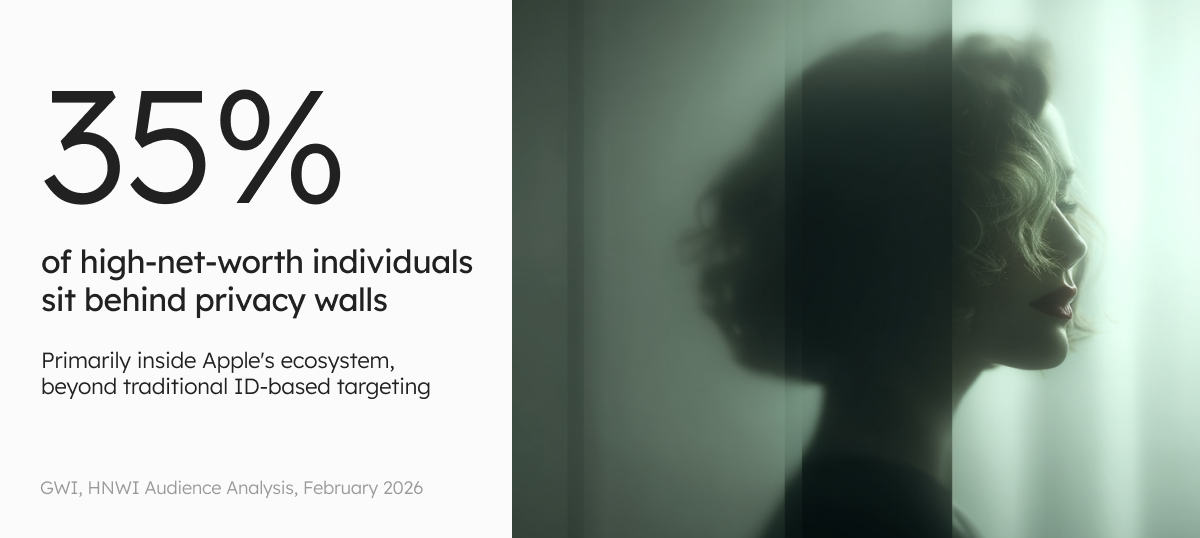
Roughly 35% of high-net-worth individuals sit behind privacy walls, primarily inside Apple’s ecosystem – a segment conventional ID-based targeting was never built to read. (Audience data throughout: GWI, HNWI Audience Analysis, February 2026)

The implication is uncomfortable for any brand still planning luxury media off a third-party audience file: a meaningful share of the people you most want to reach are, by design, invisible to an identity-based stack. The good news is that invisibility to identity is not invisibility altogether – it just calls for a different way of reading the audience, which is where the rest of this piece goes.

The Hidden Diamond effect

This is what we call the Hidden Diamond Effect: wealth that is concentrated, valuable and largely invisible to traditional digital targeting. Digital marketing was built to listen for noise: clicks, conversions, logged-in sessions, cross-site tracking. But wealth moves in silence. The more an audience can afford discretion, the more they buy it.

That has two consequences for brand planning.

luxury-context-tracking-vs-understanding_1x

First, scale is misleading. A campaign optimised against the addressable high-net-worth individuals pool (the part of the audience that is logged in, identifiable, and trackable) is, by definition, optimised against the least selective slice of that audience. The most discreet users are the most valuable users, and they are the ones missing from the dataset.

Second, demographic targeting is doubly limited. Once because the data is sparse, and once because it never described luxury behavior accurately in the first place. A 45-year-old executive in Paris could be a wellness seeker, an art collector, a private aviation client, or someone shopping for a watch as a once-in-a-decade gift. Four people. Four motivations. One useless profile.

From tracking to understanding

If identity-based targeting cannot find this audience, what can?

A better identifier was never the answer – a better question is. Instead of asking who is on this page, ask what the page is actually about, and what kind of lifestyle the reader is signalling. That shift, from tracking to understanding, is what makes the open web reachable again for luxury.

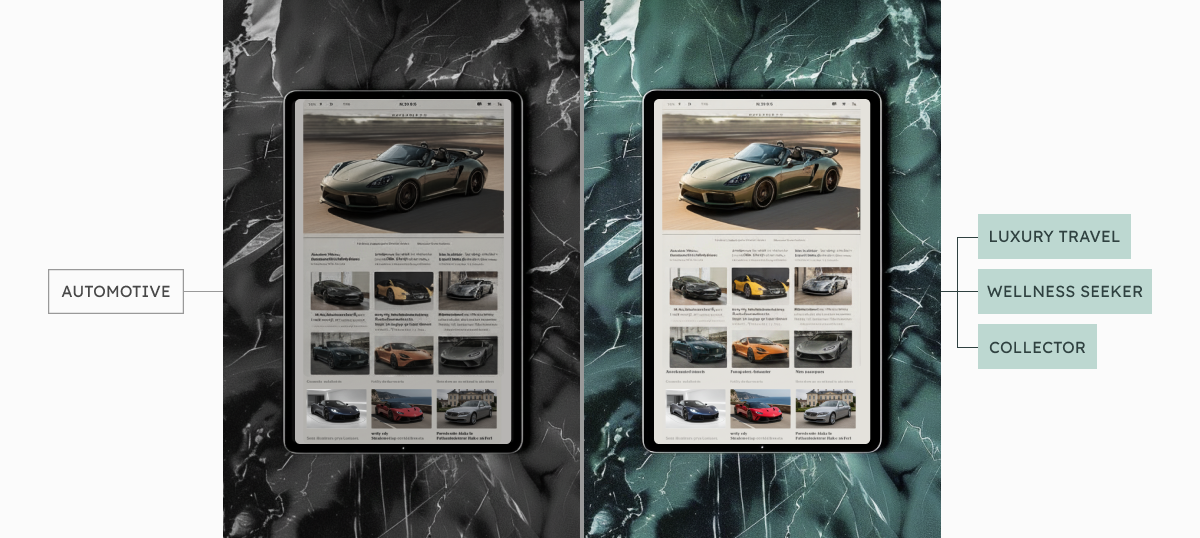
Modern contextual targeting, built on large language models, doesn’t stop at category metadata. A standard contextual system reads a page about a new sports car and labels it Automotive. Adlook’s contextual intelligence reads the same page and recognises it as a luxury travel cue, a collector signal, or a wellness seeker moment, depending on the language, the brands referenced, the lifestyle context.

In Adlook’s index, lifestyle-rich environments break down very differently from how standard contextual tools would describe them: Travel at 45.7%, Technology at 9.6%, Art at 8.8%, Luxury Lifestyle at 2.3%, with food, automotive, fashion and wellness layered underneath. Each category maps to a real behavioural moment, and together they unlock incremental, unique reach of +36% versus other leading DSPs (Nielsen incremental reach study, March to April 2025), driven primarily by the privacy-first inventory Adlook accesses through content understanding. The audience was always there. Now the tooling reads it.


In luxury, the brand defines the value

Reach alone, of course, was never the point in luxury. Perception is.

Luxury is defined by asymmetry. Broad aspiration builds desire, but selective visibility sustains prestige. Desired by many. Owned by few. That balance is delicate, and most digital media plans break it. They optimize for cheap impressions in unsafe environments, then wonder why brand equity erodes.

luxury-brand-safety-23-percent_1x

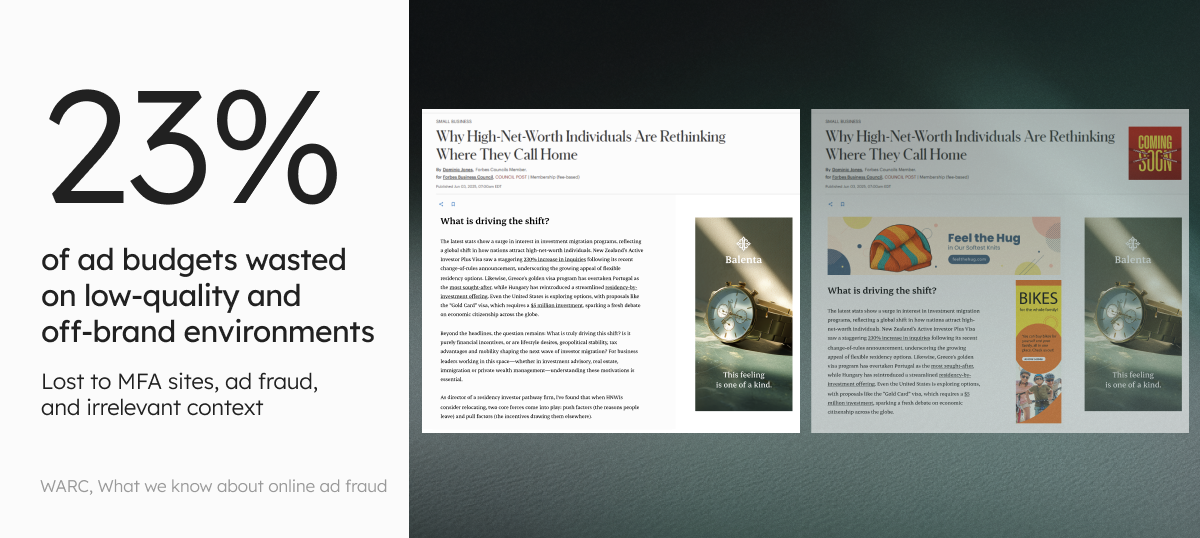
The numbers are not subtle. According to WARC’s work on online ad fraud, nearly 23% of advertising budgets are wasted on low-quality and unsafe content: MFA sites, ad fraud, irrelevant context. And over 60% of advertisers say brand safety and ad fraud are their biggest concerns in 2025. A mass-market brand can write that off as an efficiency problem. Luxury can’t: a handbag worth six figures cannot be sold next to misinformation, and no efficiency argument changes that.

The case for context-aware, brand-safe inventory in luxury isn’t really about defence. It’s about building value. The environment a brand appears in shapes the message itself. Adlook’s own research with UK luxury consumers (N=9,602, October 2025) found that 34.9% of luxury buyers purchase primarily for personal pleasure or pride, for what the object signals back to them. The medium they encounter the brand in feeds directly into that signal.

The website is the experience

There is one more shift worth naming, because it inverts a lot of received wisdom about where luxury attention now lives.

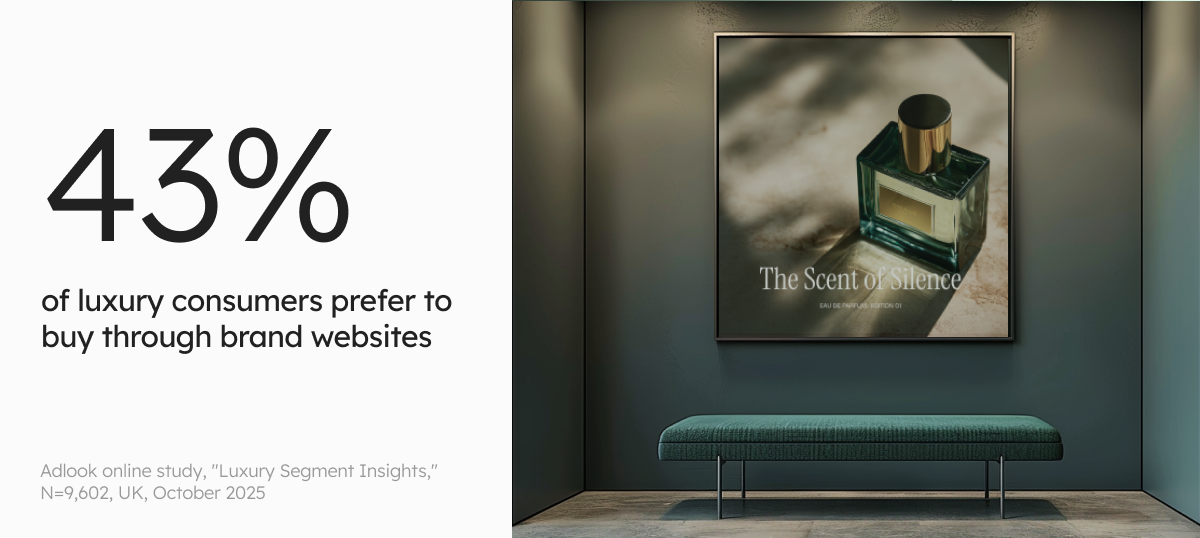
Despite years of investment in social commerce, the brand-owned web has reasserted itself as the centre of the luxury experience. In our UK study, 43% of luxury consumers prefer to buy through brand websites, compared to 16.5% via physical retail. Even more striking, 30.9% prefer to engage with brands via brand websites, versus 16.5% who turn to Instagram or TikTok for inspiration (Adlook online study “Luxury segment insights”; N=9,602, October 2025).

luxury-brand-website-43-percent_1x

Unlike brand websites, social feeds compress everything to the same scale and the same template. They are the only environment a luxury house fully controls. And the audience knows it. The website is where the brand is most itself, and the audience comes there to meet it on those terms.

That gives a luxury media plan one clear job: deliver audiences into the brand experience at the moment they’re ready, rather than trying to replace it. Deep-learning models, which run far more computations than standard machine learning, can detect rising intent across the open web and move engagement from awareness to consideration to conversion, all within the brand’s own logic. The creative format adapts: a digital atelier for discovery, a refined editorial moment for consideration, an immersive sensory experience for the visitors closest to purchase.

Three principles for luxury in the open web

Pulling this together, three principles emerge for any luxury brand planning open-web media in 2026.

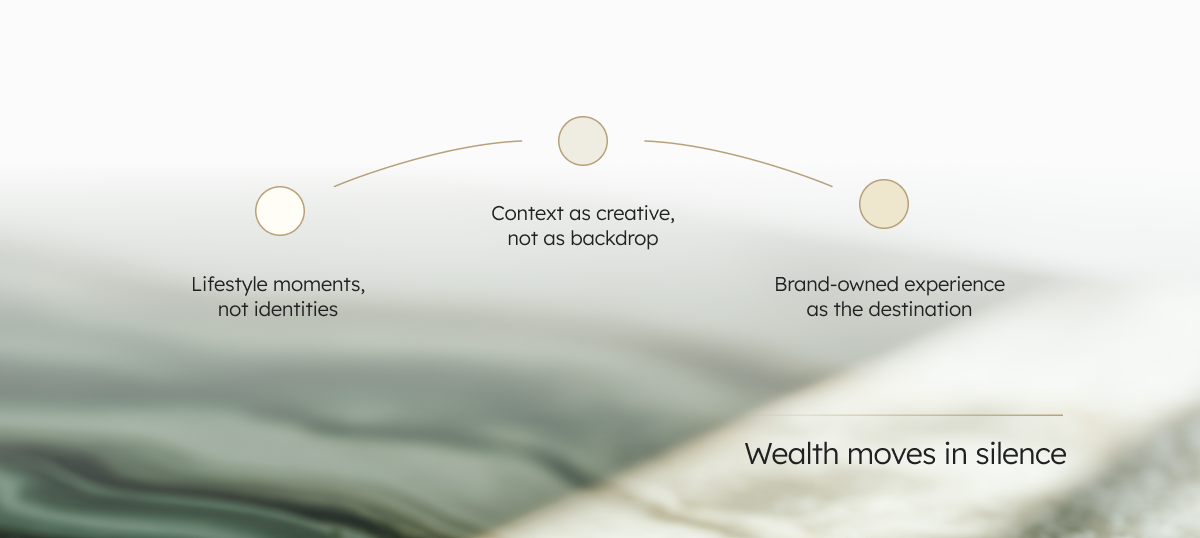
1. Stop targeting identities. Start targeting lifestyle moments.

HNWI audiences cannot be reliably reconstructed from ID-based data. They can be reached with high precision through real-time content understanding when an LLM reads the page the way a human curator would. Motivation, not demographic, is the unit of targeting.

2. Treat context as part of the creative.

In luxury, the environment is the message. Curated inventory, brand suitability, and creative formats built for premium perception aren’t a checkbox. They’re the product itself. In luxury, that 23% of wasted budget doesn’t just disappear. It shows up later as eroded perceived value.

3. Build the funnel around the brand-owned experience, not around marketing metrics.

The website is where the brand defines itself, and that isn’t unique to open-web media. It holds for the entire luxury funnel: every channel’s real job is to bring the right person to the website, where the brand controls the experience fully. Open-web media’s role is to deliver that person in at the right moment – in discovery, exploration, or conversion – and then get out of the way. Done right, that reach doesn’t stop at awareness; it carries through to the business outcome the brand is actually planning for.

luxury-three-principles_1x

The takeaway

Luxury’s relationship with digital has been awkward for over a decade. The category is too discreet for performance media, and too valuable to ignore. The audience hasn’t changed. It has been quietly behind the wall for years. What’s different for luxury is how much these fundamentals matter: content-level understanding, deep-learning journey modelling, immersive creative and curated, brand-safe inventory count for more here than in almost any other industry, because in luxury, how a brand shows up is the value proposition.

Wealth moves in silence. Brands that learn to listen for lifestyle, not identity, are the ones that will reach it – and reach it where it converts into lasting brand value.

Sources:

  1. GWI, HNWI Audience Analysis, February 2026.
  2. Adlook Bid Request Data, 2025 (privacy-first inventory reach across iOS).
  3. Nielsen incremental reach study with Adlook and other leading DSP platform, March to April 2025.
  4. Adlook online study, Luxury Segment Insights, N=9,602, UK, October 2025.
  5. WARC, What we know about online ad fraud, 2025.
  6. WARC Report, Top Five Trends in Luxury Goods.